About Reading
11 August 2025
re-edited: 13 December 2025
‘No matter how many times you shuffle the cards, the cards that appear remain unchanged.’
- From my guardians -
In my readings, I primarily utilise the Marseille Tarot deck, developing my own approach based on Oswald Wirth's analysis of the Tarot. Having regarded Eliphas Levi as equally significant as other artists since my youth, I also incorporate Crowley's Thoth Tarot into my scope, though I fundamentally do not use the Rider-Waite deck, which is widely employed today. Furthermore, I experiment with methods that differ somewhat from conventional card readings. I regard this tarot/oracle reading as a “means of dialogue with the soul”, Thinking it to convey (or express) the mind of the divine (cosmos), spirits, and nature, much like a shaman. Unless this dialogue is explained in words, practically speaking, nothing exists beyond the cards themselves. However, “what is” already exists, and one could simply verbalise it. Yet I also believe it is possible to attempt conveying the situation as it is, without doing so intentionally. Furthermore, I also experiment with reading methods akin to “REISI (spiritual view or clairvoyance)”, though this too is not an interpretation based on the original, inherent meaning of the Tarot. Rather, it involves valuing the images and words gained from the chosen Tarot cards, the situation at hand, sensations, intuition, or spiritual insight. Of course, this may simply be a matter of brain/body function or some psychological phenomenon, but I have little interest in the academic approach of seeking empirical validation for such fields in the real world. My sole concern lies in accepting and analysing the “being” as it is, for myself.
For a long time (in fact, there was a gap of about ten years), I pursued self-expression as a freelancer centred on contemporary music and art. However, as art and “things” are intrinsically linked, and one becomes fixated on mastering their materiality, it inevitably follows that one becomes subject to the capitalist economy. When art becomes excessively popularised, interest wanes for works whose inherent abstraction or conceptual nature offer no “answer”. Conversely, this “answer” becomes standardised and controlled, leading to the exclusion of anything different. Particularly since the modern era, academic justification has become increasingly necessary, even surpassing the creative value of the work itself. I believe a similar trend is visible within the field of tarot, especially among users of the Rider-Waite deck, Kabbalah, and numerology supporters. It resembles school education: the unprincipled overuse of gurus and guidebooks, alongside their materialistic economic standardisation. Common forms of divination, often seen in fortune-telling and astrology, are part of a statistical business model and differ from what we mean by “reading” here. One might find greater accuracy and satisfaction consulting artificial intelligence than a fortune-teller. (Frankly, I myself am utterly exhausted by these points.) The reality is that these statuses are gradually crumbling. Both Eliphas Levi and Helena Blavatsky, whom I respect, though differing in their historical contexts, stances towards the sacred, and interpretations, share a common critique: the (commercial/scientific) populism and vulgarisation of occultism and theosophy.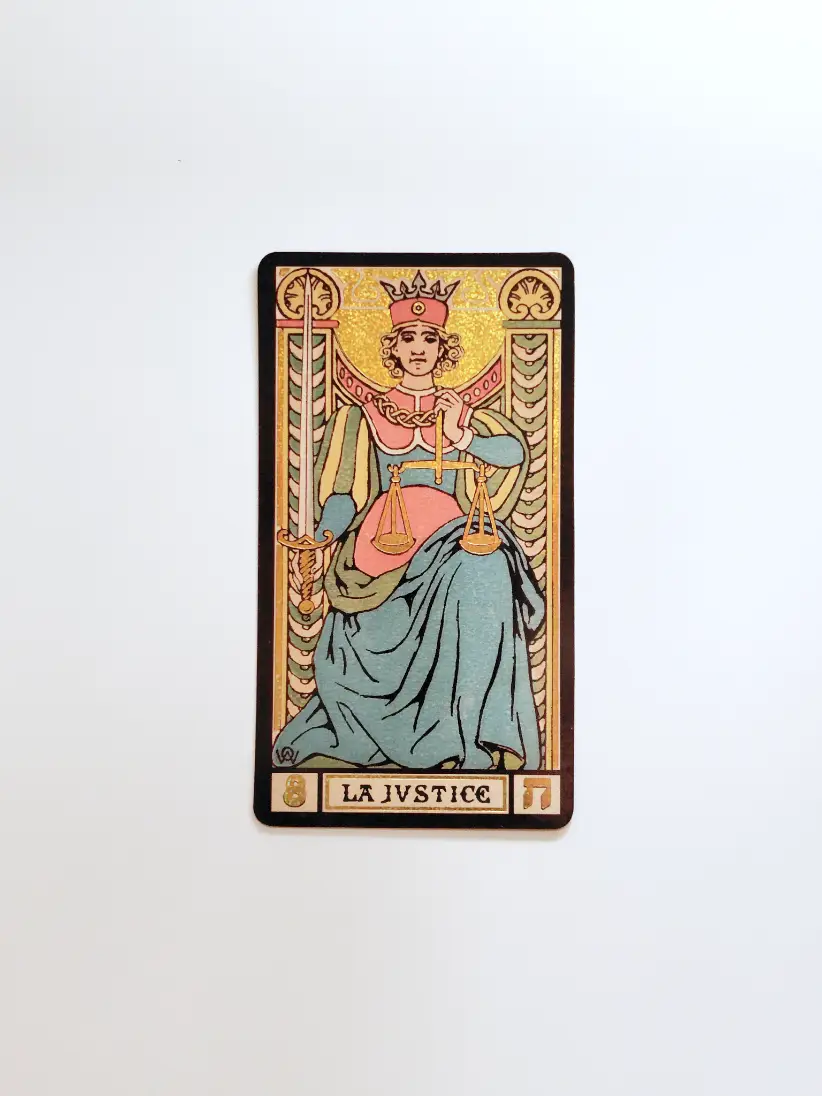 In his 1927 work, Oswald Wirth interpreted the Tarot's eighth card, “Justice”, as “The hand of the operations of nature” within the context of theosophy.
He posited that art serves nature, and that “the laws of nature” compel the attentive artist not to undertake anything contrary to the immutable order of things.
He interprets that the artist endeavours to express, through this “hand”, the “harmony of wisdom and intention that brings order to the cosmos”.
If I were to interpret this “hand” – an analogy for craftsmanship – as the reader and the act of reading,
then here, inevitably and naturally, “what is = the laws of nature” already exists,
and in some cases, I believe neither its result nor explanation is required.
I believe it is profoundly important to intuitively grasp and feel the very essence of an existence that leaves no trace for the eye or ear.
For my position here is merely that of a “reader” and “sender”.
Translated with DeepL.com and Self
In his 1927 work, Oswald Wirth interpreted the Tarot's eighth card, “Justice”, as “The hand of the operations of nature” within the context of theosophy.
He posited that art serves nature, and that “the laws of nature” compel the attentive artist not to undertake anything contrary to the immutable order of things.
He interprets that the artist endeavours to express, through this “hand”, the “harmony of wisdom and intention that brings order to the cosmos”.
If I were to interpret this “hand” – an analogy for craftsmanship – as the reader and the act of reading,
then here, inevitably and naturally, “what is = the laws of nature” already exists,
and in some cases, I believe neither its result nor explanation is required.
I believe it is profoundly important to intuitively grasp and feel the very essence of an existence that leaves no trace for the eye or ear.
For my position here is merely that of a “reader” and “sender”.
Translated with DeepL.com and Self